 12/12/2025
The unsorted household waste produced by Italian citizens hides an “untapped potential” of particularly valuable raw materials that are currently being lost forever. This is the main finding of a study carried out by Erion – in collaboration with IPLA and the Politecnico di Milano – aimed at estimating the residual presence of specific waste streams managed by the Erion System that are mistakenly thrown into mixed municipal waste.
Conducted between July 2024 and July 2025, the study is based on 38 samples of unsorted waste collected in 15 Italian cities. The sampling was performed to identify: Waste from Electrical and Electronic Equipment (WEEE, Groups R4 – small appliances – and R5 – lighting equipment), portable Waste Batteries (WB), Textile Waste and, on an experimental basis, packaging waste from EEE and cigarette butts.
How much waste ends up in the wrong bin
The technical-scientific investigation estimated – based on results from the various cities – the volumes of waste that could potentially be recovered each year from mixed municipal waste at national level. The study found a total of 945,675 tonnes of recoverable waste, broken down into 100,872 tonnes of WEEE (R4 and R5), 5,820 tonnes of portable WB, and 838,983 tonnes of Textile Waste.
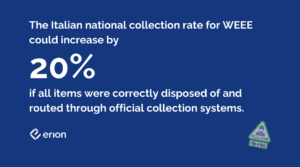
If correctly disposed of, these quantities could be added to those currently managed by official collection systems, contributing to an increase in national collection rates. In particular, the collection rate for WEEE (R4 and R5) could rise from 17% to 37%, and for portable WB from 25% to 52%, moving Italy closer to the regulatory targets of 65% for WEEE and 45% for portable batteries. The collection rate for Textile Waste would also increase significantly, from 13% to 74%.
The proposal: Expand communication and strengthen collection systems
The presence of WEEE and waste batteries in mixed municipal waste has serious economic and environmental consequences. In particular, when citizens fail to sort these waste streams correctly, it becomes impossible to collect them and therefore to properly recycle the secondary raw materials they contain. As a result, new natural resources must be extracted to meet supply needs, with significant impacts in terms of sustainability.
To reverse this trend, the Study suggests focusing on two main actions:
- promoting awareness and communication campaigns to inform citizens about how to correctly dispose of WEEE, waste batteries, and the other waste streams covered by the Research, as well as the benefits of doing so;
- enhancing local collection systems by investing in their development and accessibility.
About
The WEEE Forum a.i.s.b.l. is an international association representing 49 producer responsibility organisations across the globe. Together with our members, we are at the forefront of turning the extended producer responsibility principle into an effective electronic waste management policy approach through our combined knowledge of the technical, business and operational aspects of collection, logistics, de-pollution, processing, preparing for reuse and reporting of e-waste. Our mission is to be the world’s foremost e-waste competence centre excelling in the implementation of the circularity principle.
Transparency Register ID 702397445-73.
Copyright 2019-2025 All Rights Reserved
Contact
Legal Address:
Working From_The Hoxton
Sq. Victoria Régina 1
1210 Brussels
Belgium
Newsletter
Subscribe to our mailing list to get the updates to your email inbox.