 28/11/2025
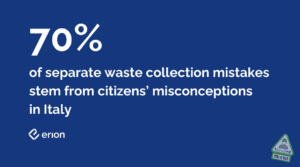
While 87% of Italians consider littering extremely serious, 70% of those who incorrectly throw recyclable waste into the general waste bin say they do so because they “believe it is the right thing to do.” The most frequent mistakes involve items people want to get rid of but do not know where to dispose of properly. At the top of the list are textiles (rags 41%, shoes 27%, and bags 23%), followed by small WEEE (electric toothbrushes 21%, chargers 13%) and packaging waste (12%). The situation is less critical for spent batteries, with only 8% being incorrectly discarded.
This is the snapshot that emerges from the survey conducted by Ipsos Doxa Italia for Erion, which maps the impact of communication on citizens’ waste-related behaviours, and from the technical-scientific study commissioned by Erion to identify which recyclable materials end up in unsorted municipal waste. Both sets of results portray an Italy that is informed but not very responsive, clearly highlighting the need for an integrated model that combines more widespread infrastructure with communication capable of translating into practical knowledge for citizens.
The findings of the study were presented during the event “Sustainability and Awareness: A Survey on Unsorted Waste and the Role of Communication in Transforming Behaviours”, organised by Erion at the Ara Pacis Museum in Rome to mark International E-Waste Day (celebrated worldwide on 14 October).
“The results show us that citizens are allies who are asking for enabling conditions to carry out proper separate waste collection,” emphasised Andrea Fluttero, President at Erion. “We need to increase practical knowledge and reduce citizens’ distrust in the system, as well as develop technologies and market solutions to better address the challenges of circularity. We need accessible, visible infrastructure and targeted, repeated campaigns that always conclude with concrete instructions. Communication does not simply inform: it enables correct actions, reduces errors, and strengthens civic responsibility.”
Convenience and proximity: the key to increasing separate waste collection
Citizens have a high level of awareness regarding the obligation to sort waste: 92% for spent batteries, 86% for WEEE, 77% for packaging waste and 71% for textile waste.
However, confirming the gap between knowledge and action, each year in Italy 0.12 kg per capita of spent batteries are still thrown into unsorted waste (compared to 0.06 kg per capita collected through the official channel), 1.98 kg per capita of small WEEE (vs 1.34 kg per capita) and 17 kg per capita of textile waste (compared to 2.74 kg per capita). For packaging waste, the various sampling exercises produced results that were too inconsistent.
Italians therefore ask for simple and nearby solutions, allowing waste sorting to take place along everyday routes. For WEEE, 40% appreciate being able to drop them off in stores without having to purchase an equivalent product (“one-for-zero” take-back). For spent batteries, 49% prefer containers placed in supermarkets. For textiles, the most appreciated locations are everyday shopping destinations, such as shopping centres (30%), supermarkets (26%) and retail stores (26%).
Municipal recycling centres remain useful for bulky waste and scheduled drop-offs, but they show practical limitations for small waste items. 49% of respondents would like extended opening hours, and the “dedicated trip” (an average of 13 minutes) is seen as unsuitable for small items. Almost one in two Italians would prefer an intermediate solution between a fixed facility and hyper-proximity: a mobile collection service operating every two weeks. Less of a priority, but still notable, are options such as post offices/municipal offices (24%) and schools (10%), which highlight the potential of leveraging already frequented locations.
About
The WEEE Forum a.i.s.b.l. is an international association representing 49 producer responsibility organisations across the globe. Together with our members, we are at the forefront of turning the extended producer responsibility principle into an effective electronic waste management policy approach through our combined knowledge of the technical, business and operational aspects of collection, logistics, de-pollution, processing, preparing for reuse and reporting of e-waste. Our mission is to be the world’s foremost e-waste competence centre excelling in the implementation of the circularity principle.
Transparency Register ID 702397445-73.
Copyright 2019-2025 All Rights Reserved
Contact
Legal Address:
Working From_The Hoxton
Sq. Victoria Régina 1
1210 Brussels
Belgium
Newsletter
Subscribe to our mailing list to get the updates to your email inbox.